 2 months ago
43
2 months ago
43

David HaleDec 2, 2025, 08:16 PM ET
- College football reporter.
- Joined ESPN in 2012.
- Graduate of the University of Delaware.
The first College Football Playoff rankings came out five weeks ago. They looked a lot like tonight's rankings.
We've had precious little movement at the top, with a few teams jockeying up or down a slot, but effectively no seismic shifts in the landscape. BYU and Texas are the only two teams that were projected in the field in the committee's first ranking that aren't now -- and they're just barely on the outside with reasonable arguments for inclusion.
Teams ranked in the top 18 by the committee this year are a combined 55-9, with six of those losses coming to other teams ranked in the top 18. All three outliers are courtesy of -- you guessed it -- the ACC (Louisville to Cal, Virginia to Wake and Georgia Tech to Pitt).
That's a massive anomaly. Last year, top-18 teams at this point had lost 19 games, including 14 to teams outside their own grouping. Top-10 teams are 33-4 this year. In the first 11 years of the playoff, top-10 teams had lost an average of nine games by this point in the season.
The two words that best describe this year's playoff push are "status quo."
That, of course, has been bad news for all the teams on the outside looking in -- from those with valid cases such as Miami, BYU and Vanderbilt, to underdogs like USC, Utah or Arizona that might've had a shot in a more chaotic year.
But the real loser in this copy-and-paste rankings season is all the fans who just want to see things get weird. It's a sad state of affairs when we're left to rely on MACtion and the ACC to do all the heavy lifting when it comes to college football drama. The power players need to step up -- or, perhaps, ratchet down -- their game to add a bit more drama.
The good news is, the committee's ad-hoc reasoning, mush-mouthed explanations and mind-boggling about-faces still leave plenty to argue about, even if the big picture hasn't changed all that much.
Here's this week's biggest slights, snubs and shenanigans.


1. Texas Longhorns (9-3, No. 13)
It's not entirely clear how this committee values wins. For the past month, the priority has certainly appeared to be about who has the better losses (unless, of course, you're Alabama).
That seems a foolish way to prioritize playoff teams, since the goal of the playoff isn't to lose to good teams but to win games.
Does Texas have a bad loss? Yes. A 29-21 defeat to woeful Florida -- even if the Gators also played Georgia and Ole Miss close and just walloped a team that beat Alabama head to head -- is problematic.
But look who Texas has beaten: No. 7 Texas A&M by 10, No. 8 Oklahoma by 17 and No. 14 Vandy by three (in a game they led by 24 in the fourth quarter). That's the résumé of a team capable of winning a national championship -- even if the Horns were also capable of losing to a second-rate SEC team.
Are we trying to find teams with the most upside or give participation trophies to the ones who've not lost an ugly one? (Except, again, Alabama.)
And it's not as if the committee believes an extra loss is disqualifying. Oklahoma, Alabama, Notre Dame and Miami all have two losses and are ranked ahead of one-loss BYU (more on that in a moment), so what's the harm of moving a three-loss Texas ahead of a two-loss team that has accomplished less?
This all comes back to the most frequent and justified criticism of the committee: The same rules aren't applied evenly. In some cases, record matters. In some cases, best wins matter. In some cases, better losses matter. The standard varies based on the team being considered. But if the committee is going to err in favor of anyone, it should probably do so for a team that's proven -- not once, not twice, but three times -- that it can beat an elite opponent.
Oh, and moving Texas up ahead of, say, Notre Dame would also have the added bonus of allowing the committee to sidestep another tricky situation. Which leads us to ...


2. (tie). BYU Cougars (11-1, No. 11) and Miami Hurricanes (10-2, No. 12)
We're putting these two teams together, because we've already lamented the committee's utterly disingenuous evaluation of them repeatedly, so it feels redundant to keep going down the same rabbit hole. But, for the sake of two programs being astonishingly misevaluated, let's do one more round.
For Miami, the logic is obvious: The Canes beat Notre Dame head to head.
But let's keep going. Miami's two losses -- SMU and Louisville -- would rank as the fourth- and fifth-toughest games on Notre Dame's schedule, had the Irish played them. Instead, Notre Dame has cruised through an essentially listless slate. Six of Notre Dame's 10 wins came against teams that beat zero or one other Power 4 opponent. Stanford -- seriously, Stanford! -- is Notre Dame's fourth-best win (by record). Yes, Notre Dame played well enough in losses to two very good teams, but one of those teams has the same record and is somehow ranked lower! Even if this is strictly about the "eye test," there's little argument for ignoring the head-to-head outcome. Notre Dame's strength of record is 13th. Miami's is 14th. Notre Dame's game control is fifth. Miami's is sixth. If all else is the same, how is head-to-head not the deciding factor?
Yet, here's a little more salt in the wound for the Canes: Had Florida State finished 6-2 instead of 2-6 in ACC play, Miami would've won the (fifth) tie-breaker for a spot in the ACC title game and could've locked up its place in the playoff by simply beating Virginia. Instead, the Canes will sit at home and watch and hope and, at this point, probably get left out. Chess, not checkers, by rival FSU.
As for BYU, the committee's desire to overlook the Cougars makes no sense. Let's take a look at a blind résumé, shall we? (Note: Best wins and composite top 40 based on an average of SP+, FPI and Sagarin ratings.)
Team A: No. 6 strength of record, No. 14 game control, best win vs. No. 11, next vs. No. 28, loss to No. 5, four wins vs. composite top-40, five wins vs. teams that finished 7-5 or better
Team B: No. 7 strength of record, No. 10 game control, best win vs. No. 13, next vs. No. 27, loss to No. 7, three wins vs. composite top-40, two wins vs. teams that finished 7-5 or better
Now, just based on that information, Team A would seem the obvious choice. Now what if I told you Team B just lost its head coach, too?
That's right, Team A is BYU, and Team B is Ole Miss. Every bit of data here suggests the Cougars are, at worst, on even footing with the Rebels or ahead, and yet the committee has Ole Miss ranked five spots higher.
This is, arguably, the second year in a row in which BYU was clearly the most overlooked team in the country.

3. Notre Dame Fighting Irish (10-2, No. 10)
A week ago, Notre Dame was ranked one spot ahead of Alabama.
Then on Saturday, the Irish beat 4-8 Stanford by 29 (in a game they at one point led 42-3), while Alabama beat 5-7 Auburn by 7 (in a game the Tigers had a chance to tie before fumbling in Tide territory late).
The committee looked at those two results and said, "You know what, We like what we saw from the Tide! Move 'em up!"
What could possibly be the logic for shifting opinions on these two teams? The only other team that jumped another winning team was Texas, and the Longhorns beat the No. 3 team in the country emphatically, not a second-tier team that fired its head coach a month ago.
Oh, and hasn't the committee made it pretty clear losses are supposed to matter? Well, Notre Dame has two Ls to teams ranked in the top 12. Alabama got beat by a Florida State team that finished 5-7.
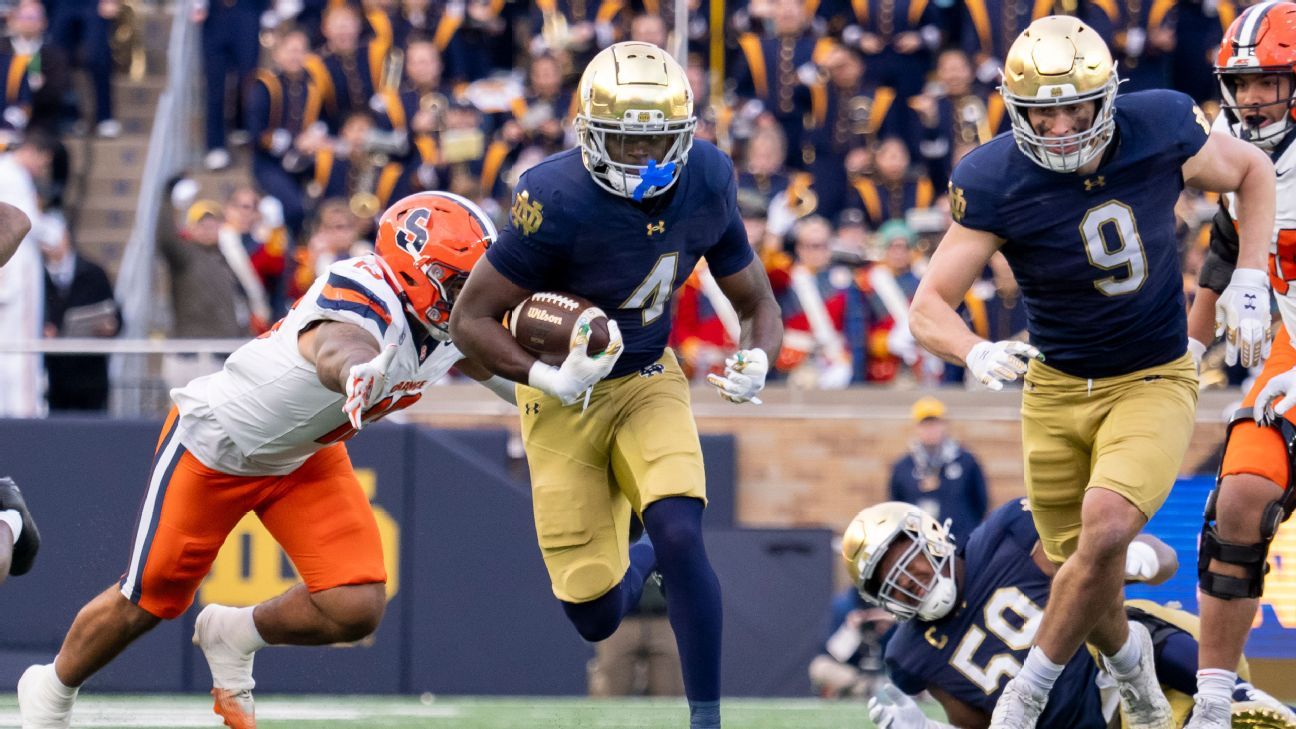
Even by the eye test, this makes little sense. Notre Dame has proven to be one of the most complete, dominant teams in the country, with a secondary that's near impossible to throw on, a rookie QB who has been nearly flawless, and a running back who may well be the best player in the country. Alabama, on the other hand, has a one-note offense that can't run the football.
We're not believers in using advanced metrics as a ranking of accomplishment, but if this is simply a "who's better" debate ...
SP+ ranks Notre Dame fifth and Alabama 12th.
FPI ranks Notre Dame third and Alabama sixth.
Sagarin ranks Notre Dame second and Alabama seventh.
FEI ranks Notre Dame fourth and Alabama ninth.
So, again, we ask: Why would the committee possibly make this change?
We'd wager you know the answer. That sticky Canes-vs.-Irish head-to-head debate is a real headache for the committee. But if Notre Dame's currently the last team in and something unexpected happens this weekend (hello, BYU over Texas Tech), then the committee can do as it did in 2014 and wash its hands of a tough choice and keep both Notre Dame and Miami out.
(It's also interesting that a seven-point win over a team with a losing record is enough to jump Notre Dame, but a 31-point win over a ranked Pitt did nothing for Miami's relative placement with the Irish despite -- and we're not sure anyone has mentioned this yet -- a head-to-head win!)
But, speaking of Alabama ...


4. Championship game participants
Step into the time machine with us for a moment, all the way back to championship week 2024. Here's the state of play: Alabama, at 9-3, is ranked No. 11, the first team out of the playoff and also out of the SEC title game. Still, the Tide and the SEC hope there's a pathway to salvation because SMU -- 11-1 and ranked eighth -- still has a game to play against Clemson in the ACC championship. If the Mustangs were to lose, couldn't the committee then justify slotting SMU behind Alabama based on another data point, even though the Tide were simply sitting at home watching the action?
This was the case being made throughout the run up to the ACC championship last season. SMU, which should've been celebrating a miraculously successful first season in the Power 4, spent hours upon hours defending itself against criticism that it didn't belong in the same conversation with big, bad Bama. Rhett Lashlee hinted he thought the committee's vote was rigged, SMU players lamented their status on the chopping block despite a ranking that should've put them safely in the playoff field, and SEC commissioner Greg Sankey made the rounds arguing that Alabama's (and Ole Miss's and South Carolina's) strength of schedule ought to put them ahead of SMU (and others).
OK, back to the present day. Here we are, with Alabama sitting perilously on the dividing line between in the field and out -- a week ago, they would have been the last team in, but of course the committee had other ideas this time around -- with a game to play against Georgia in the SEC championship. An ACC team (Miami) sits just a tick behind the Tide in the rankings, but it will be off this week.
So, what happens if Alabama loses?
The comparison to last year's SMU isn't even a particularly fair one. The Mustangs were at No. 8 before the ACC title game. Alabama is at No. 9 (and probably should be a spot or two lower). SMU's game against Clemson was new territory. A loss to Georgia would actually undermine Alabama's best argument for inclusion -- the three-point win in Athens in September. And while SMU ultimately did make the playoff field last year, a last-second loss on a 56-yard field goal still dropped the Mustangs from No. 8 to No. 10 in the rankings.
Play this scenario out now: Alabama, ranked at No. 9, plays a team that currently counts as the Tide's best win. Imagine if Georgia wins the rematch and does so convincingly. The committee docked SMU two spots for a last-second loss, so surely it would do at least that much to Alabama for a more convincing defeat, right? And here's the other thing: Even with the ACC title game loss last year, SMU was 11-2 -- one less loss than Alabama had. A Tide loss in the SEC title game now would be defeat No. 3 -- one more than Notre Dame or Miami or (presumably) BYU.
It's hard not to see a conspiracy here given the committee's inexplicable flip-flop between Alabama and Notre Dame. It's hard not to see brand bias in how the Tide's championship week narrative diverges from SMU's a year ago. It's not at all hard to envision a scenario where Alabama loses to Georgia, gets in as the last team anyway, and it's all explained away as a completely reasonable decision.

5. James Madison Dukes (11-1, No. 25)
Well, the committee finally weighed in on more than one team outside the Power Four -- mostly because it was just impossible to find enough Power Four teams worth ranking -- and the news isn't good for JMU. With the committee deciding already that North Texas is the higher ranked team, the Dukes' only hope for the playoff would seem to be a Duke win in the ACC title game.
But what exactly has the committee seen to warrant that decision? Check out the numbers.
Best win (by average FPI, SP+ and Sagarin ranking)
JMU: No. 54 Old Dominion
UNT: No. 62 Washington State
Next best
JMU: No. 62 Washington State
UNT: No. 68 Navy
Loss
JMU: No. 29 Louisville
UNT: No. 24 USF
Wins vs. bowl-eligible
JMU: six
UNT: five
Strength of record
JMU: 18th
UNT: 22nd
FPI
JMU: 28th
UNT: 37th
There are certainly some check marks in North Texas' favor, including a more impressive win over common opponent Washington State and a slightly better SP+ ranking, but on the whole, James Madison has had the tougher path here. That can reasonably change should UNT beat Tulane, but the committee should've waited for that to happen. Instead, they've made it clear JMU isn't sniffing the playoff unless it comes at the expense of the ACC.
Also angry this week: Vanderbilt Commodores (10-2, No. 14); The ACC leadership who voted on its tie-breaker policies; Manny Diaz, who has to try to make a coherent argument for his five-loss Duke Blue Devils getting in ahead of a one-loss JMU; Every 8-4 team with a markedly better résumé than 9-3 Houston who isn't ranked this week; Lane Kiffin's yoga instructor and Juice Kiffin's dog walker.