 2 months ago
73
2 months ago
73
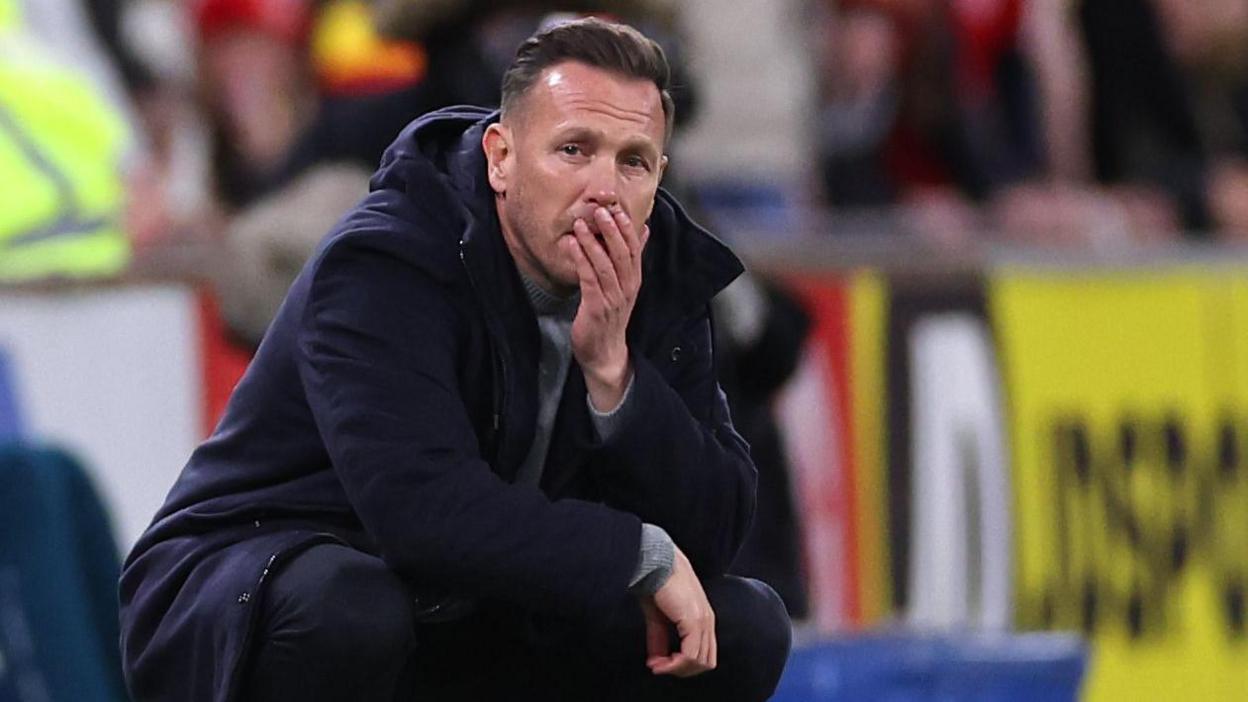 Image source, Getty Images
Former Wales captain Craig Bellamy was appointed head coach in July 2024
ByDafydd PritchardBBC Sport Wales and Chris WathanBBC Sport Wales
It will take some time for Craig Bellamy and his Wales players to get over the agony of missing out on World Cup qualification.
Once the pain of their penalty shootout defeat in Tuesday's play-off semi-final at home to Bosnia-Herzegovina is a little less raw, they have some big issues to address.
One of them is Bellamy's own future. This is his first senior managerial role and the former Liverpool and Manchester City forward has already caught the eye of club sides, but it remains to be seen how his failure to qualify for this summer's World Cup will affect his stock.
The Wales squad and its lack of strength in depth is also under scrutiny, having been exposed during the campaign and on Tuesday in particular.
Then there are matters off the field, with the Football Association of Wales (FAW) counting the financial cost of the failure to qualify.
Wales braced for club interest in Bellamy
In the early days of Bellamy's tenure, he kept saying he would not be in Wales for long, a not-so-subtle hint that he saw his future in club management.
Although the former Wales captain signed a four-year contract when he was appointed head coach in July 2024, even some of his employers at the FAW thought he might only stay for this World Cup campaign.
However, the longer Bellamy has spent in the job, the more he has enjoyed it, and it is becoming clear he plans to honour his contract.
The biggest factor is Euro 2028, which Wales will co-host with England, Scotland and the Republic of Ireland.
Bellamy is desperate to lead Wales at that tournament and, having privately told the FAW as much, he has also started to mention it in public.
Interest from clubs is inevitable. Bellamy has distanced himself from links to Celtic, but others are bound to follow, with the FAW braced for offers.
For the time being, he is committed to Wales until 2028, with the obvious proviso that things could change if a big club comes calling.
Missed opportunities, costly mistakes
Bellamy "disappointed" Wales couldn't hold on for play-off win against Bosnia
It remains to be seen whether those offers materialise after a campaign in which Wales excited and had chances to qualify automatically, but ultimately fell short.
Bellamy was unapologetic for wanting an intense and attacking approach to games, which could also leave them exposed at the back.
It was summarised by a game in Brussels where they trailed 3-0 to top seeds Belgium, before brilliantly fighting back to level a game that would have given them control of the group - only to concede from a late defensive lapse.
As with the home 4-2 defeat to the Red Devils, there was a naivety to the way in which they gifted their opponents chances throughout.
Bellamy's convictions were a strength at times during the campaign, with a dazzling 7-1 dismantling of North Macedonia the highlight.
And there is no doubt the players have all bought into the ideals and instructions, quick to point out after the Bosnia game that they believe there is more to come.
But the head coach's absolute belief in his methods occasionally strayed into dogma, and his apparent refusal to adapt - or incorporate just a little more pragmatism - proved costly.
Lack of strength in depth exposed
Highlights: Wales' World Cup dream ended by Bosnia-Herzegovina and penalties
Questions have been raised whether game management on the pitch or on the sideline should have been better.
Bosnia was a case in point, with some supporters critical of the substitutions made as Wales lost control of the game - and their destiny - in a key period.
Yet, while Bellamy refused to blame the lack of depth, it was undeniably a factor.
One of Bellamy's intentions has been to end the notion of Wales as a ''small football nation", resonating with many in Welsh football and in keeping with ambitions that are bigger than other associations of a similar size.
But, in the here and now, Wales' top-level player pool was not enough to cope with some key withdrawals at a crucial time.
Captain Aaron Ramsey missed the entire campaign. Tottenham Hotspur's Ben Davies was the side's calm voice of experienced leadership, yet injury ruled him out of the final two regular qualifiers as well as the play-offs.
Connor Roberts had been a significant lieutenant for Bellamy having previously worked with him at Burnley but has been out for a year.
Add in defender Chris Mepham and goal threat Kieffer Moore, Wales were without 354 caps worth of experience in their squad for the play-offs.
Then there was having to try and muster the most of those out of form at club level such as Brennan Johnson, or short on minutes such as Dan James.
Wales will benefit from the development of youngsters, including Cardiff City's Dylan Lawlor, and there is genuine excitement about a squad that - like the manager - has the ability to improve.
But cumulatively, it took a toll.
Financial implications of missing out on qualification
It won't just be the fans missing out on the chance of experiencing this summer's tournament. The play-off defeat means the FAW will miss out on a much-needed financial boost - with budgets feeling the squeeze as a result.
Wales earned around £10m from the 2022 World Cup - players are thought to have pocketed a third of that in bonuses, a third covered tournament costs and the remainder of around £3m was ploughed back into the game.
Although the expansion of this summer's tournament means that take-home may have been less, it would have still been a welcome cash injection for an association that is expected to make a loss in its next accounts following an aggressive investment policy.
Chief executive Noel Mooney has overseen a move to eat into the FAW's reserves in a bid to make hay while the sun is shining.
Money has been both spent and allocated to grow the game via grassroots, including facilities - severely lacking in some areas of the country - as well as a bid to revamp the domestic league system.
Failure to qualify is not expected to halt plans, with qualification said to be a bonus rather than something banked on.
And rather than the 2026 World Cup, the revenue associated with co-hosting Euro 2028 was deemed to justify the speculative approach.
But with the loss of boosts to commercial and sponsorship revenue for the next 12 months and beyond, there is no doubt the FAW will feel the pinch.
And with a new 10-year strategy due to be announced this summer, there will be interest in whether missing a second major tournament will necessitate at least some scaling back of ambition.