 3 months ago
38
3 months ago
38

Seth WalderJan 22, 2026, 06:25 AM ET
- Seth Walder is an analytics writer at ESPN, specializing in quantitative analysis. He is also a regular on "ESPN Bet Live" and helps cover sports betting. Seth has been at ESPN since 2017. He previously worked at the New York Daily News covering the Jets and Giants. You can follow Seth on X via @SethWalder.
The NFL's Most Valuable Player award will very likely come down to Rams quarterback Matthew Stafford and Patriots quarterback Drake Maye. Even if you agree that they were the two most valuable players in the league this season -- spoiler alert, I do not! -- there are several interesting questions beyond those two. While the NFL's MVP almost has to be a quarterback, how far down the list of candidates do we have to go until we get to a non-QB? How far do we have to go until we get to a center? A safety? Or a running back?
Because the NFL MVP award itself rarely answers these questions, I take it upon myself to submit a 100-player ballot. There were a lot of players who played well this season. So why not rank them? This is my fourth annual attempt at doing just that.
To evaluate players, I rely on a variety of sources -- statistics and quantitative metrics, awards such as the All-Pro team, and feedback from NFL front office personnel and colleagues at ESPN. One of my favorite parts about football is that player evaluation is far from a settled science. Every season, including this one, someone I trust in the league will tell me I have a player ranked far too high and another person who I have similar trust in will tell me that same player is ranked far too low.
In this exercise, we are measuring player value relative to average at respective positions. So we will almost certainly have quarterbacks at the very top -- it is the highest leverage position -- but also cannot have more than 16 on the list. This also means we will have more edge rushers than centers, for example. And this is an entirely descriptive exercise about only the 2025 season.
So let's dive in to the 100-player ballot, starting with my real pick for MVP.


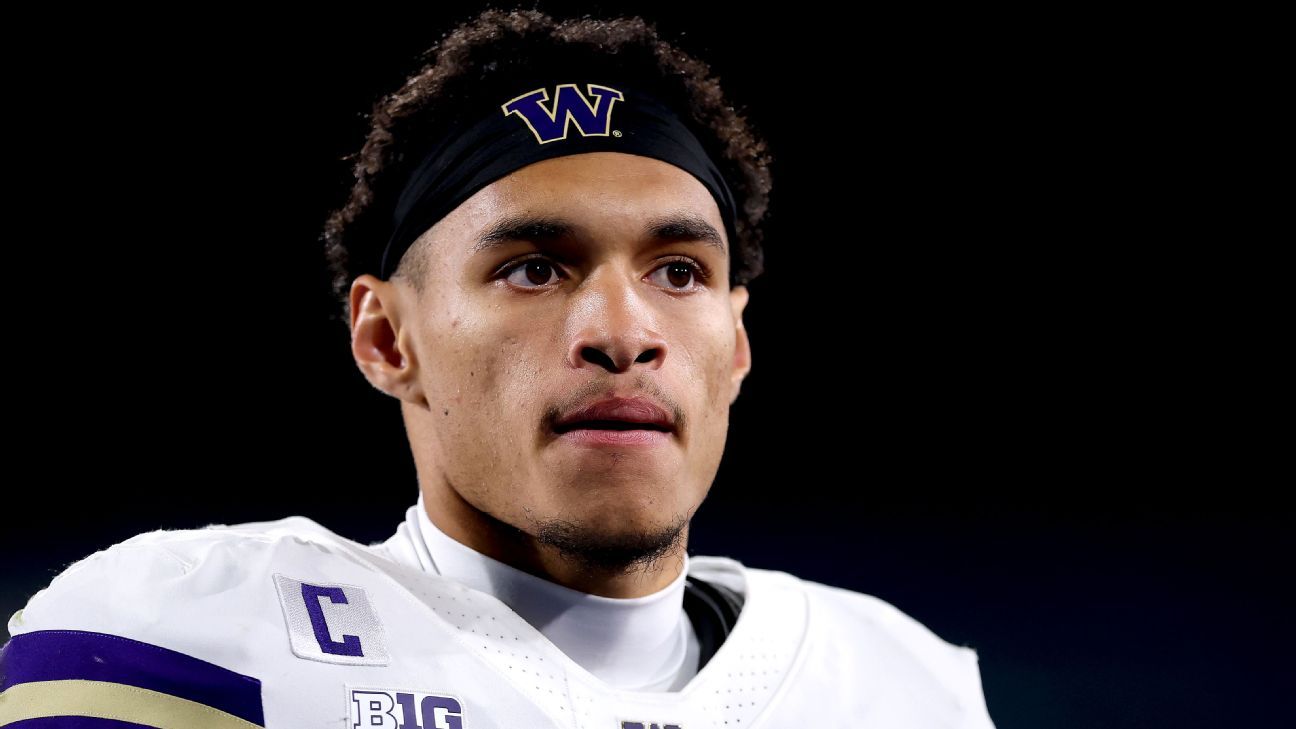
1. Drake Maye, QB, New England Patriots
Maye might not be the NFL MVP when it is announced Feb. 5 ... but he should be. And while it was a close race throughout the season, I don't think it was really that close at the end.
Maye finished as the NFL's QBR leader by a healthy margin, with his 77.2 being well ahead of the next-highest finisher (Jordan Love at 72.9). And because QBR already adjusts for opponent quality, Maye's big lead takes into account the Patriots' easy strength of schedule.
How did Maye pull it off? Mainly with accuracy and a big helping of explosive plays. Maye led QBR-qualifying quarterbacks in yards per dropback (7.7), adjusted completion percentage (78.8%) and completion percentage over expectation (plus-9%). That last number represents the best CPOE season by any quarterback in the NFL Next Gen Stats era (since 2016). Maye recorded 54 plays that generated at least two expected points added, tied for the second most in the NFL. And his 8.7 air yards per attempt was third highest, and he threw to the sticks or farther on 47% of his attempts (fourth highest).
Critically, the Patriots heavily relied on Maye. New England had a 3.7% pass rate over expectation, per NFL Next Gen Stats, the second highest in the league. In quarterback points above average -- essentially the volume version of QBR -- Maye (57.1) drastically outperformed prime MVP contender Matthew Stafford (42.5), who ranked third.
Maye also led the league in scramble rate (10.3% of dropbacks) and ranked second in total scramble EPA (plus-26.8). He really had just one weakness: taking sacks, which he did 7.8% of the time, higher than the 6.2% average. But that's hardly enough to knock him off the top spot.
And metrics aren't the only reason I feel Maye is the clear MVP. He also did all this in more difficult circumstances relative to Stafford and the other top candidates. He did not have a superstar receiving group. He did not have a Hall of Fame playcaller. And he was not supported by a super strong running game, a ton of play-action (25% of dropbacks vs. Stafford's 36%) or a great offensive line. Those factors are not fully captured by the efficiency and production metrics -- which makes Maye's season even more impressive.

2. Dak Prescott, QB, Dallas Cowboys
Prescott has been absent from the MVP conversation, but I strongly believe that is a mistake. Let's start with the obvious reason he was ignored: wins. Dallas was 7-9-1. Are we truly incapable of considering the team-sport element of football when voting for awards? With the quarterback for the NFC's No. 5 seed (Stafford) potentially winning MVP this season, we sometimes draw a distinction between team and player. I believe that same courtesy ought to be extended to great quarterbacks like Prescott who miss the playoffs thanks to his team's poor defense.
Prescott's numbers are right there. He ranked fifth in QBR, but his volume metrics were stronger due to the Cowboys' considerable reliance on him. Prescott added 46.1 points above average, second only to Maye and ahead of Stafford. Prescott ranked third in completion percentage over expected, per NFL Next Gen Stats (plus-4%), and was fourth in off-target rate (11%).
It is harder to play quarterback when trailing because you are forced into more clear passing situations. Prescott played only 26% of his snaps this season with the lead -- a dramatic difference from Maye (54%) and Stafford (46%).
The counterargument against Prescott is that he had two exceptional receivers to throw to in George Pickens and CeeDee Lamb. While that's valid, Stafford's top two receivers are elite, too. Ultimately, Prescott should not be punished for the Cowboys' decision to trade away Micah Parsons or their general defensive failures. Regardless of Dallas' place in the standings, the numbers point toward Prescott being the second-most valuable player this season.

3. Matthew Stafford, QB, Los Angeles Rams
I recognize this ranking is lower than the consensus but make no mistake -- Stafford had an incredible season. He finished fourth in QBR, second in adjusted net yards per attempt, first in air yards per attempt, third in yards per dropback and third in points above average. The Rams' offense ranked second in EPA per play, third in EPA per dropback and second in success rate on dropbacks. They led the league in EPA per drive (0.83), too. The Rams were pass-leaning, with their plus-2% pass rate over expectation (per NFL Next Gen Stats) being sixth highest.
Stafford's turnover rate was 1.6%, seventh best and just barely ahead of Maye (eighth) and Prescott (ninth). While Stafford had a good offensive line, that he was sacked only 3.7% of the time is a testament mostly to him and one area where he was clearly superior to Maye.
But Stafford's accuracy numbers were not on par with the other contenders -- he ranked 13th in completion percentage over expected and 20th in off-target rate -- and his lack of running ability was a negative, though those numbers are mostly baked into the EPA-based metrics. So while Stafford should be in the mix for MVP, I have a hard time getting him to No. 1 based on the combination of those numbers and further context they do not consider.
The Rams had the NFL's highest success rate on designed runs and Stafford enjoyed the highest rate of play-action (36%) of any quarterback. He used designed rollouts on 12% of dropbacks (second most) and faced eight-man boxes on 11% of dropbacks (third). The Rams ranked fifth in pass block win rate (69%). He played with two exceptional receivers in Puka Nacua and Davante Adams, and had Sean McVay calling plays for him.
Even with all that support, Stafford still had to play remarkably well to compile the numbers he did. But it wasn't remarkable enough to be No. 1 for me.

4. Josh Allen, QB, Buffalo Bills
Allen's argument is based on the amount he has to shoulder with the Bills. Despite a lacking wide receiver room, Allen managed to rank seventh in QBR and sixth in points above average.
He had the lowest off-target rate among QBR-qualifying quarterbacks and, of course, added a ton of value on the ground. Allen ranked first in EPA on designed runs (29.4), with 12.8 coming on tush pushes, and sixth in EPA on scrambles (20.9). Allen had a good offensive line in front of him and a solid run game, though his personal running threat surely helped non-QB runs, as well.
1:41
Is Joe Brady the right coach for Josh Allen?
Jason McCourty explains why Joe Brady might be the right person to lead Josh Allen and the Bills.
Ultimately, this was not one of Allen's best seasons, and his early-season struggles -- he ranked 11th in QBR through Week 6 -- should not be overlooked. But he was still massively impactful. Allen isn't top-five based on his efficiency numbers alone, but considering who he was throwing to and his impact on every aspect of the Bills' offense, he still was one of the five most valuable players this season.

5. Jordan Love, QB, Green Bay Packers
Love very quietly finished second in the league in QBR (72.8) -- behind only Maye. He wasn't a true contender for MVP because the volume wasn't there. He missed the final two games of the season and was also held back by the Packers' run-heavy leanings -- with a minus-6% pass rate over expected (26th), per NFL Next Gen Stats.
Despite that, Love finished fourth in QB points above average because of how efficient he was when he did drop back to pass. His efficiency stems from mistake avoidance and accuracy. Love recorded only eight turnovers (six interceptions) and took sacks at a 4.3% clip, well below average. His plus-4% completion percentage over expected ranked fifth best. And when a quarterback can do all that while averaging the third-highest rate of 20-plus-air-yard throws (13%) and the sixth-highest air yards per attempt, the results are going to be strong.
6. Patrick Mahomes, QB, Kansas City Chiefs
This was a down year for Mahomes, but he was still one of NFL's the most valuable players given the importance of the position he plays and his relative efficiency. Mahomes finished the season ranked sixth in QBR and fifth in points above average, despite missing the last three games after tearing his ACL and LCL on Dec. 14.
Mahomes' accuracy number was an uninspiring minus-3% relative to expectation, third worst among QBR-qualifying quarterbacks this season. His scrambling was an asset, though, as he contributed 23.6 expected points added on scramble plays.
Mahomes also had to overcome his receiver group. Kansas City's team receiver score -- based on player tracking metrics that evaluate each receiver's ability to get open, make the catch and generate YAC relative to expectations on each play -- for its wide receivers and tight ends was a 32 on a scale of 0-99, the third-worst mark in the league. Mahomes suffered a 7.6% drop rate, also third worst. He also faced light boxes 76% of the time, the fourth-highest rate among quarterbacks.
While Mahomes' numbers weren't what we're used to seeing from him, he was still one of the most valuable quarterbacks in the league.

7. Justin Herbert, QB, Los Angeles Chargers
Herbert was not done any favors this season, as the Chargers' offensive line was one of the weakest units in the NFL. Los Angeles lost left tackle Rashawn Slater to injury before the season and right tackle Joe Alt went down after just six games played, too. The result? A 53.9% team pass block win rate, the worst in the NFL by a healthy margin.
That kind of protection can sink quarterback numbers. But Herbert still managed to finish 13th in QBR and eighth in points above average despite opponents quickly beating his offensive line repeatedly. He suffered 129 quarterback hits and was contacted 206 times in the 2025 regular season, leading all QBR-qualifying quarterbacks in both categories.
His accuracy was solid, with a plus-3% completion percentage over expected that ranked eighth. But where Herbert particularly shined this season was scrambling, adding 24.3 EPA on scrambles, fourth most in the NFL and a huge increase from his 16th-place ranking in 2024. He added the seventh-most EPA on designed runs, too.

8. Jaxon Smith-Njigba, WR, Seattle Seahawks
I flip-flopped Smith-Njigba and Puka Nacua several times when making this list, so consider this a 51-49 decision that truly could have gone either way.
Smith-Njigba was unbelievable this season. The box-score metrics speak for themselves: 119 receptions for a league-leading 1,793 receiving yards. His 3.85 yards per route run not only led the NFL this season, but it was the third-best season in the metric since at least 2007 (as far back as we have route data). He led the league in yards per route run (4.06) and had the ninth-best drop rate at 0.6% -- far better than Nacua's 2.4%.
Moving mostly to outside receiver this season, Smith-Njigba's 35% target rate and 25% reception per route rate each ranked second to Nacua. And Smith-Njigba's 2.72 completed air yards per route led the NFL. He also achieved all this with a far inferior quarterback throwing him the ball relative to Nacua -- and without another receiving teammate to scare defenses.
9. Puka Nacua, WR, Los Angeles Rams
Like Smith-Njigba, Nacua's box score metrics were extremely impressive, starting with a league-leading 129 receptions for 1,715 yards. His 3.81 yards per route run trailed only Smith-Njigba and was fourth best among wide receivers since at least 2007. Nacua led the league with a 37.1% target rate and 28.7% reception per route rate, despite having a great receiver opposite him in Davante Adams. And Nacua's plus-168 YAC over expected, per NFL Next Gen Stats, ranked second among wide receivers behind only George Pickens.
Nacua's best argument over Smith-Njigba stems from player tracking metrics. In ESPN's receiver scores, Nacua ranked first with a 97 on a 0-99 scale. That was the third-best WR season in overall score in the metric's history (since 2017), behind A.J. Brown in 2024 and Antonio Brown in 2017.
Nacua makes his presence felt as a blocker too. While we don't have perfect metrics to capture that part of his game, he recorded 73 run block wins this season, second most among wide receivers.
While there's reasonable debate between Nacua and Smith-Njigba for WR1, these were clearly the two most valuable non-quarterbacks of the 2025 season.
10. Myles Garrett, Edge, Cleveland Browns
The Browns might have had only five wins this season, but Garrett certainly held up more than his fair share of the bargain with his record 23 sacks.
His pass-rushing numbers were actually just behind a couple of players on a down-to-down basis. Garrett's pass rush win rate of 20.6% ranked fifth best among all players and he finished third in total pass rush wins behind Micah Parsons and Will Anderson Jr. Garrett also finished fourth in sacks created -- a metric that credits the first player to beat their blocker on a play that ultimately ended in a sack -- with 15.0. But Garrett was either double-teamed or chipped on 39.5% of his pass rushes this season, per NFL Next Gen Stats, more than any other edge rusher.
Plus, the 23 sacks were undeniable, so Garrett deserves his top-10 spot.

11. Will Anderson Jr., Edge, Houston Texans
If it wasn't for Garrett setting the single-season sack record, Anderson easily could have been the favorite for Defensive Player of the Year. He had a little more than half the sacks Garrett did (12), but Anderson's 62 pass rush wins were second in the NFL behind only Parsons. And Anderson did all that while ranking eighth in run stop win rate at edge (28.2%), too.
12. Micah Parsons, Edge, Green Bay Packers
The Packers got only 14 games out of Parsons in his first season in Green Bay, but he delivered 17 games worth of production. He delivered 66 pass rush wins (most in the NFL) and 64 pressures (also No. 1) along with 12.5 sacks. And he was efficient, too, with a 23.4% pass rush win rate at edge that ranked only behind Nick Herbig (who played far less) and Nik Bonitto.
Perhaps the best Parsons stats were Green Bay's splits with him on and off the field. With Parsons, the Packers recorded a 43.9% pass rush win rate (would be fourth-best) and 0.01 EPA allowed per play (14th-best). Without him, those numbers dropped to 28.1% (32nd) and 0.12 (29th).
13. Jeffery Simmons, DT, Tennessee Titans
Simmons' career was quite successful entering 2025, but he never earned first-team All-Pro honors and always was in the shadow of Aaron Donald and/or Chris Jones. But this season, Simmons was the league's best defensive tackle, a lonely bright spot on the 3-14 Titans.
Simmons recorded a 15% pass rush win rate at defensive tackle (second best at the position behind Jones) along with 11.0 sacks and 12.0 team sacks created. That he accomplished this on the Titans makes it even more impressive. Because they were always behind, Simmons had far fewer pure pass rush opportunities against opponents in desperate passing situations compared to many of his peers.

14. Kyle Hamilton, S, Baltimore Ravens
Perhaps no number tells the story of Hamilton's impact this season more than the Ravens' defensive performance on the 128 snaps without him on the field. On those plays, Baltimore allowed a massive 0.27 EPA per play, which would be by far the worst of any defense in the league. With him on the field, the Ravens' defense was average. Granted, on-off splits in football can be awfully noisy, but it matches the consensus view of Hamilton -- that he's indispensable to Baltimore's defense. And he's incredibly versatile.
"He can do everything," one front office personnel staffer said. "Big, athletic, so capable of handling any matchup from anywhere on the field."
The Ravens traded for safety Alohi Gilman ahead of Week 6, which wildly changed Hamilton's role. Prior to the trade, Hamilton played safety 72% of the time, but from Week 6 on that number dropped to 4% (!), with him aligning everywhere from slot defender to linebacker to on the line of scrimmage. And the Ravens' defense got much better after Hamilton did that, too.
15. George Pickens, WR, Dallas Cowboys

16. Garett Bolles, OT, Denver Broncos
A first-team All-Pro, Bolles ranked ninth in pass block win rate at 94%. But I feel that number sold him a little short. He was frequently penalized for plays where he pushed an outside rusher too deep to be a real threat to the quarterback (a known weakness of PBWR), often walling them off. Bolles' run block win rate was above average, too, and he was the best part of an exceptional offensive line that was key to the Broncos' run to the No. 1 seed in the AFC.

17. Amon-Ra St. Brown, WR, Detroit Lions

18. Quinyon Mitchell, CB, Philadelphia Eagles
Mitchell continued to ascend, making a case to be the best corner in the NFL despite not having any interceptions this season. His other numbers were strong: 0.7 yards allowed per coverage snap and 0.6 in man coverage, far better than the 1.1 average for the position. Mitchell recorded a league-best 47.7% expected completion percentage against him and was even better in actual completion percentage allowed, giving up receptions on only 41.7% of passes he faced.

19. Ja'Marr Chase, WR, Cincinnati Bengals

20. Trey McBride, TE, Arizona Cardinals
21. Nik Bonitto, Edge, Denver Broncos
22. Aidan Hutchinson, Edge, Detroit Lions
23. Trevor Lawrence, QB, Jacksonville Jaguars

24. Laremy Tunsil, OT, Washington Commanders
25. Chris Jones, DT, Kansas City Chiefs
Jones finished eighth among interior linemen in All-Pro voting after the Chiefs' disappointing campaign. While he didn't quite meet his past levels, the numbers suggest he was much better than that eighth-place finish indicates. Jones still had the best pass rush win rate at defensive tackle (20.4%), along with 7 sacks and 10.5 sacks created. And the feedback I received from front office members around the league was positive, with multiple people indicating he was the second-best player at the position after Simmons.
26. Pat Surtain II, CB, Denver Broncos
27. Maxx Crosby, Edge, Las Vegas Raiders
28. Penei Sewell, OT, Detroit Lions
29. Quinnen Williams, DT, Dallas Cowboys
In a season in which he was traded from the Jets to the Cowboys, Williams recorded only 2.5 sacks. But he was outstanding in every other metric. He recorded a 14.0% pass rush win rate at defensive tackle, fourth best at the position. His 44.4% run stop win rate as an interior lineman ranked second. And he forced three fumbles.
Does that mean the Cowboys made a good trade? Absolutely not -- the deal was completely illogical from a team-building standpoint. But that's no fault of Williams, who still had a heck of a year.
30. Dion Dawkins, OT, Buffalo Bills
Dawkins' blocking metrics were superb, as he was the No. 1 tackle in pass block win rate (95.9%) and No. 11 in run block win rate (78.2%). With the Bills lacking at wide receiver, Josh Allen needed another position group to step up and the offensive line was it. It ranked first in run block win rate as a team, springing their running backs to a league-most 3.07 yards before contact. While that was certainly a team effort, Dawkins was the best of the bunch.
But I got mixed feedback on Dawkins. One front office talent evaluator told me Dawkins was the best tackle in the league this season; two others felt he should be on the back half of this list.
31. Derek Stingley Jr., CB, Houston Texans

32. Trent Williams, OT, San Francisco 49ers
33. Jared Goff, QB, Detroit Lions
34. Kobie Turner, DT, Los Angeles Rams
35. Kamari Lassiter, CB, Houston Texans
36. Leonard Williams, DT, Seattle Seahawks
37. C.J. Stroud, QB, Houston Texans
38. Jared Verse, Edge, Los Angeles Rams
39. Cooper DeJean, CB, Philadelphia Eagles
40. Nico Collins, WR, Houston Texans

41. Darnell Wright, OT, Chicago Bears
42. Bo Nix, QB, Denver Broncos
43. Josh Hines-Allen, Edge, Jacksonville Jaguars
44. Joe Thuney, G, Chicago Bears
The reworking of the Bears' interior offensive line last offseason paid off in a major way, and Thuney was a particularly successful acquisition. He led all guards with a 97.6% pass block win rate and ranked third (77.1%) in run block win rate. Ben Johnson's offense, with all its play-action, is friendly to offensive linemen, but there's little arguing with Thuney's numbers. The Bears didn't just land a great guard in Thuney, but a Protector of the Year candidate.
1:47
Why Rex was shocked Bears didn't go for two
Rex Ryan and Dan Orlovsky question why Ben Johnson chose not to go for a go-ahead 2-point conversion late vs. the Rams.

45. Daniel Jones, QB, Indianapolis Colts

46. Bijan Robinson, RB, Atlanta Falcons
Robinson was the best running back in the NFL this season due to his combined work in both the run and pass game. Robinson recorded plus-257 rush yards over expected this season, per NFL Next Gen Stats, trailing only James Cook III and Derrick Henry. But he separated from those two in the receiving game, with Robinson ranking second behind only Christian McCaffrey in ESPN's overall receiver score among running backs, and he led all skill-position players with 257 YAC over expected, per NFL Next Gen Stats. Plus, Robinson had two fewer fumbles than Cook.
47. Derwin James Jr., S, Los Angeles Chargers
48. Creed Humphrey, C, Kansas City Chiefs
49. Lamar Jackson, QB, Baltimore Ravens
50. Jack Campbell, LB, Detroit Lions
51. Xavier McKinney, S, Green Bay Packers
52. Quinn Meinerz, G, Denver Broncos

53. Andrew Thomas, OT, New York Giants
54. Danielle Hunter, Edge, Houston Texans
55. Jordyn Brooks, LB, Miami Dolphins

56. Cameron Heyward, DT, Pittsburgh Steelers
57. Devon Witherspoon, CB, Seattle Seahawks

58. Chris Olave, WR, New Orleans Saints

59. Justin Jefferson, WR, Minnesota Vikings
60. Zack Baun, LB, Philadelphia Eagles

61. Tristan Wirfs, OT, Tampa Bay Buccaneers
62. Byron Murphy II, DT, Seattle Seahawks
63. Quenton Nelson, G, Indianapolis Colts
64. Jahmyr Gibbs, RB, Detroit Lions
65. Zach Allen, DT, Denver Broncos
66. Davante Adams, WR, Los Angeles Rams
67. Zay Flowers, WR, Baltimore Ravens
68. Jordan Mailata, OT, Philadelphia Eagles
69. Christian McCaffrey, RB, San Francisco 49ers
McCaffrey had a vexing season in which he literally finished last in rush yards over expected (per NFL Next Gen Stats) with minus-166. That number probably does not entirely separate McCaffrey from his blockers, but teammate Brian Robinson Jr. finished the season at minus-6. So I think it's safe to say McCaffrey, who averaged 3.9 yards per carry, was not a good rusher this season.
But his work as a receiver was an entirely different story. McCaffrey recorded 102 receptions for 924 receiving yards and plus-137 YAC yards over expected. It wasn't all YAC though. McCaffrey's hands are elite, which was reflected in his 99 catch score and 99 overall score relative to other running backs in ESPN's receiver metrics -- the highest a player can have.
70. DeMarcus Lawrence, Edge, Seattle Seahawks
71. Baker Mayfield, QB, Tampa Bay Buccaneers
72. Jalen Pitre, S, Houston Texans
Pitre flew around the field as the Texans' nickel back, making plays against both the run and the pass. He ranked sixth in run stop win rate among slot corners with at least 300 coverage snaps, and third in stuff percentage (the percentage of run plays where he made a tackle for zero or negative gain). And while I sometimes think we overrate on-ball production for defensive backs, it's hard to argue with Pitre's numbers -- his total target EPA of minus-34.3 was best among all nickel players, per NFL Next Gen Stats.
73. Carson Schwesinger, LB, Cleveland Browns
74. Calen Bullock, S, Houston Texans
75. Milton Williams, DT, New England Patriots
I was among the skeptics when the Patriots handed Williams a $26 million per year contract last offseason, but he was worth every penny in his first season in New England. He was third in pressure rate among interior linemen (9.6%) and would have been sixth at pass rush win rate and 10th in run stop win rate had he qualified. His availability (only 12 games played) was the only thing holding him back. A full season playing at this level would have vaulted Williams much higher on this list.
76. Tyler Smith, G, Dallas Cowboys

77. Taylor Moton, OT, Carolina Panthers
78. A.J. Brown, WR, Philadelphia Eagles
79. CeeDee Lamb, WR, Dallas Cowboys
80. Ernest Jones IV, LB, Seattle Seahawks
81. Alex Highsmith, Edge, Pittsburgh Steelers
82. James Cook III, RB, Buffalo Bills
83. Byron Young, Edge, Los Angeles Rams
84. Peter Skoronski, G, Tennessee Titans
85. Kaden Elliss, LB, Atlanta Falcons
Ellis was the league's most impactful pass rushing off-ball linebacker this season. He rushed the passer 164 times, far more than the next-most-frequent pass-rushing linebacker (Chiefs' Nick Bolton, 117). But Elliss was also efficient, with a 28.3% pass rush win rate despite pass rushing so frequently (average for off-ball linebackers with at least 50 pass rushes was 17.0%). He literally had double the pass rush wins (30) of any other off-ball linebacker.
86. George Kittle, TE, San Francisco 49ers
87. Talanoa Hufanga, S, Denver Broncos
88. De'Von Achane, RB, Miami Dolphins
89. Brock Purdy, QB, San Francisco 49ers
90. Troy Fautanu, OT, Pittsburgh Steelers
91. Jonathan Taylor, RB, Indianapolis Colts
92. Brian Burns, Edge, New York Giants
93. Stefon Diggs, WR, New England Patriots
94. Jaylen Waddle, WR, Miami Dolphins
95. Sam Darnold, QB, Seattle Seahawks
96. Derrick Brown, DT, Carolina Panthers
97. Aaron Brewer, C, Miami Dolphins
Brewer had a great season, and his blocking helped the running game be the best part of the Dolphins' season. He was so good to the point where he almost beat out Creed Humphrey for first-team All-Pro honors at center (Brewer ended up second team). But the feedback I got from a few folks in the league wasn't quite as strong -- they felt he had a good season but wasn't on Humphrey's level.
98. Joey Porter Jr., CB, Pittsburgh Steelers
99. Mike Onwenu, G, New England Patriots