 2 months ago
32
2 months ago
32

Tim MacMahonFeb 13, 2026, 07:00 AM ET
- Joined ESPNDallas.com in September 2009
- Covers the Dallas Cowboys and Dallas Mavericks
- Appears regularly on ESPN Dallas 103.3 FM
GIANNIS ANTETOKOUNMPO COULDN'T stay quiet and confused. His coach wouldn't allow it.
Early in Antetokounmpo's NBA career, he was still learning English and often felt intimidated by how fast the words flew out of the mouths of his Milwaukee Bucks coaches and teammates. Antetokounmpo especially struggled with slang and basketball terminology after spending the first 18 years of his life in Greece.
O.J. Mayo, the 2008 No. 3 pick playing for Milwaukee at the time, gave Antetokounmpo several movies such as "Friday" and "Friday After Next" to help him pick up on some of the common vernacular used by the players. But that didn't help when then-Bucks coach Jason Kidd called on Antetokounmpo in film sessions.
"I was like, 'Coach, I don't understand what you're saying," Antetokounmpo recalled recently to ESPN. "He kept saying, 'Stop using that you don't understand what I'm saying as an excuse.'"
Kidd and his coaching staff printed out a sheet filled with basketball terminology and gave it to Antetokounmpo to study. They scheduled frequent sessions in which a coach would blurt out a term from the sheet and order Antetokounmpo to demonstrate what it meant.
"I thought it would be easier for us to teach him English than him teach us Greek, even though we might have learned a couple of words," Kidd joked a dozen years later. "It worked out pretty well."
Antetokounmpo, a two-time MVP and 10-time All-Star, is one of many NBA players whose native language is not English. It has become an international league, featuring 135 players from 43 countries other than America to start the season, according to the league, so much so that the new NBA All-Star Game format features one international and two American squads.
Some of those players arrived in the NBA already comfortable speaking English, which is taught in many European schools, and used it to communicate with teammates from English-speaking countries while playing on pro teams overseas. Others had to learn the language on the fly. While the NBA has become more international over the years, the majority of the league's players are American and grew up learning and speaking a single language.
As simply put by LA Clippers veteran Nicolas Batum, who's from France: "The language of basketball is English."
THE LANGUAGE IN which a player thinks about and processes the game varies from player to player -- and sometimes changes for an individual player depending on his circumstances and surroundings.
Philadelphia 76ers center Joel Embiid, a seven-time All-Star who grew up in Cameroon primarily speaking French but is also fluent in Basaa, learned English after coming to the U.S. as a high schooler.
"Interesting question," he said. "I never thought about it."
After pondering the question, Embiid surmised his thoughts on the floor are a mix of English and French but primarily the former because it's the language in which he communicates with his teammates. Thirteen of the players on the 76ers' roster were born in the United States.
San Antonio Spurs center Victor Wembanyama, a Frenchman making his second All-Star appearance, had also never considered which language the basketball soundtrack in his mind is set to. He slid back in his locker following a road game in Memphis and thought about it for a moment.
"My thoughts are in French, but the vocabulary is in English," said Wembanyama, who spoke English fluently long before he was the No. 1 pick in the 2023 draft. "It's like every basketball term we use, it's in English and we practice it in English, and I talk to my teammates in English. But the thought process is in French."
Three-time MVP Nikola Jokic also said he translates thoughts from his native language to English on the fly while on the floor. He studied English as a child in Serbian schools but wasn't comfortable with the language when he began his career with the Denver Nuggets in 2015-16.
"When I came here, I definitely didn't have an option," Jokic said. "Oh, my first year was hilarious. It was really fun because I wanted to say something and I [couldn't] even say the coverage or whatever. So it took me a while."
That 2015-16 Nuggets team had seven players born outside the U.S., but they spoke different native languages, so English -- the language of the other 12 players who played for Denver that season -- was the obvious default.
Ivica Zubac, the Croatian big man who was traded from the Clippers to the Indiana Pacers at the deadline, said he had to train his mind to work differently. Minnesota Timberwolves center Rudy Gobert, the Frenchman who is a four-time Defensive Player of the Year, intentionally worked to rewire his mind in the same way -- although Gobert said his "deep thoughts, self-talk" still frequently come through in French. Communication is especially critical in their roles as defensive anchors.
"You have to communicate in English," Zubac said. "Everything I see and think I got to communicate. And if I thought about it in Croatian and then have to translate it in my head to English, then say it, it would be too slow."
Antetokounmpo said he became comfortable with English basketball jargon by his third season and mastered the language while courting his wife, Mariah, an American, soon thereafter. His internal monologue goes from Greek to English depending on whether he's playing for his national team or in the NBA.
"I think [about] the game in the place that I play," Antetokounmpo said.
His subconscious fluctuates similarly. His dreams bounce between the languages based on which one he's speaking most often at the time.
"I'm always waking up and I'm like, 'Am I the only person that this happens to or does it happen to other people?'" Antetokounmpo said.
He's not alone, even among NBA superstars.
"This happens when I'm dreaming," said Los Angeles Lakers guard Luka Doncic, the six-time All-Star who spoke Slovenian, Serbian and English while growing up in Ljubljana, Slovenia, and learned Spanish while spending most of his teenage years playing for Real Madrid Baloncesto in Spain. "If I'm in the U.S., it's a lot of English. Then, if I'm back home, I dream in Slovenian.
"It's kind of the same with basketball. It's wherever I'm at in the moment."
Cleveland Cavaliers coach Kenny Atkinson tried to meet his players where they were at while serving as an assistant coach for France's national team during preparation for the Paris Olympics in 2024. Atkinson studied French, but it certainly doesn't come naturally to him, resulting in similar translation delays in communication that international players have experienced when coming to the NBA.
The players appreciated his effort, but it was quickly apparent that it wasn't the most efficient way of communicating.
"Hey Kenny, you tried," Batum recalled telling Atkinson. "[Speak] English."
That's how Batum has been communicating with teammates since well before he was selected in the 2008 draft. He started practicing with the pro team of the French club LeMans when he was 15 years old. With players from around the world on the roster, much of the communication between teammates -- and basketball terminology -- was in English.
Kristaps Porzingis, who grew up in Latvia and played professionally in Spain before arriving in the NBA in 2015, said he doesn't even know how to say a lot of basketball terms in his native language. That's because Latvians just use basketball terminology borrowed from Americans.
"Basketball language is like a different language," said Porzingis, who was recently traded from the Atlanta Hawks to the Golden State Warriors. "Even when we go back to [the] national team and stuff, a lot of stuff we say in English anyway."
2:28
Has All-Star Weekend lost its 'sizzle and significance'?
Stephen A. Smith shares his thoughts on the All-Star Game following Kevin Durant's comments criticizing the lack of effort from the international players.
THE INTERNATIONAL PLAYERS who are accustomed to speaking English basketball terminology before arriving in the NBA tend to struggle with the cultural transition as much as the language. Several players recalled early problems communicating in their daily lives off the court, especially those who came over with no grasp of English.
"When you come over, the basketball part was easy," Batum said. "You have to learn all the tricks outside. I remember my first time when I got here, I had to go to the bank and I was scared as s---. But on the practice court, I was fine."
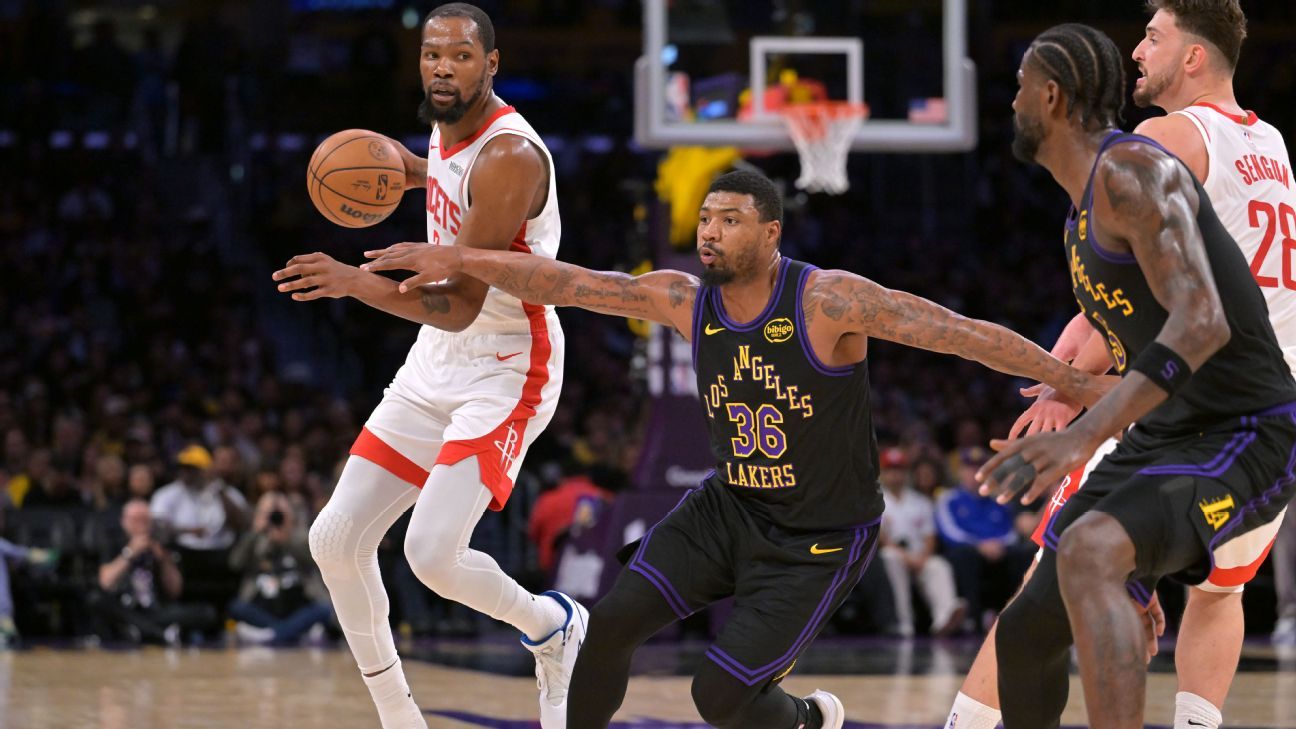
Houston Rockets center Alperen Sengun, an All-Star for the second straight season, relied heavily on an interpreter after leaving Turkey for the NBA in 2021. Orhun Gungoren, a Turkish former pro basketball player, lived with Sengun and was constantly by his side.
Gungoren served as an interpreter for every media interview Sengun did. He also facilitated communication with him during practices, team meetings and film sessions as Sengun learned English.
"I was kind of understanding a little bit [of] whatever they say," Sengun said. "I wasn't just talking much. And I think that was the whole point in my first year, just trying to understand it.
"I kind of had zero English when I came to the U.S. So my first year was like, I would say I barely was talking English. I was just bulls---ting."
Sengun realized that using Gungoren as a crutch was slowing down the process of learning a new language, stunting his development as a player. After about six months, he intentionally went places without Gungoren, forcing himself to communicate in English. His English improved rapidly. Gungoren eventually transitioned into a role on the Rockets' coaching staff.
When Sengun plays for the Turkish national team, he goes back to communicating almost solely in his native language. There is one exception.
"Maybe just if I talk trash, that's English," Sengun said. "Trash talking is better in English."
During the Paris Olympics, Wembanyama surprised observers by celebrating a clutch bucket in group play with an English expletive.
"Let's f---ing go!" Wembanyama shouted after making the dagger bucket in France's overtime win over Japan.
"That's a basketball player thing," Wembanyama told reporters when asked about forgoing French in that moment. "I think in Mongolia, Australia or the North Pole, they say it."
ESPN's Tim Bontemps, Dave McMenamin and Michael C. Wright contributed to this story.