 3 months ago
61
3 months ago
61
Christmas is a time when we’re encouraged to have too much of everything - TV, food, time with family, and football.
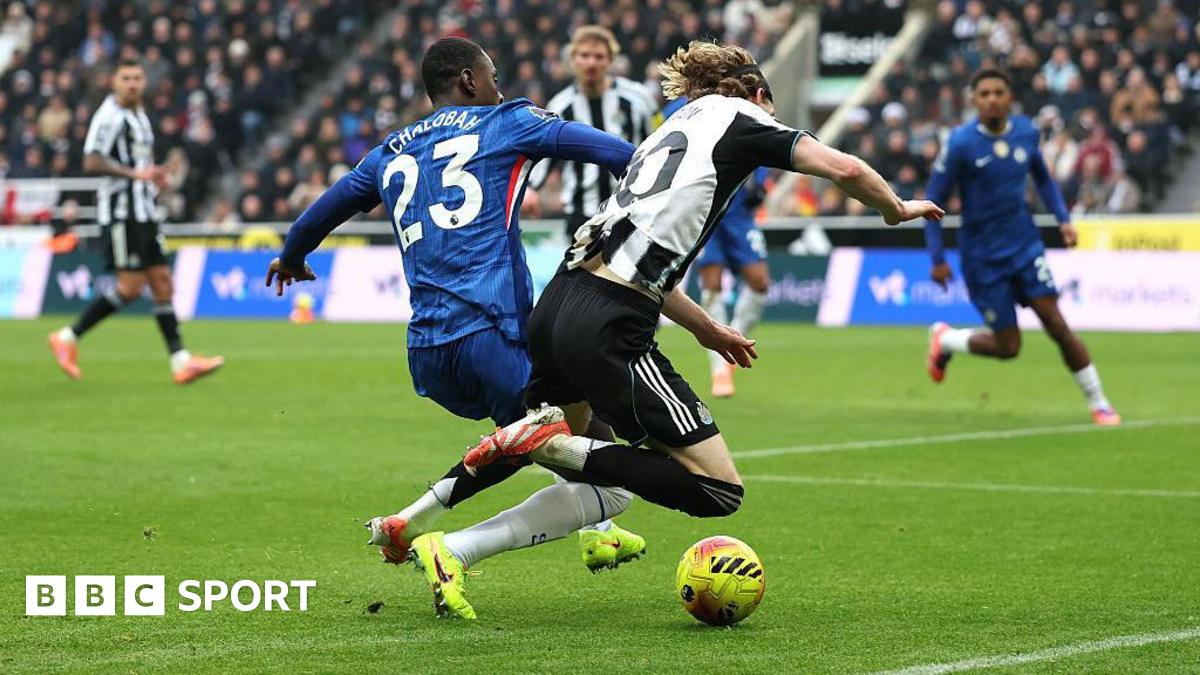
Premier League teams are expected to play twice a week over Christmas, including Boxing Day and New Year's Day.
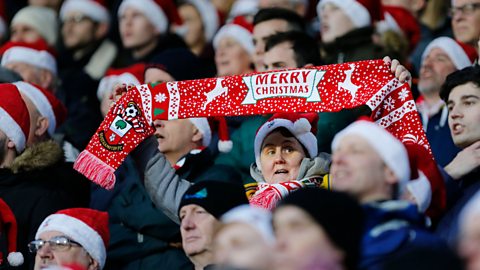
There’s only one Merry Christmas
In most of Europe, it is custom to have a minimum two week winter break over Christmas - although Italy introduced a Boxing Day football fixture for the first time in 2017.
It might be tempting to blame the broadcasters, but the UK has a history of games at Christmas rooted in medieval traditions and hard-fought workers rights that goes back long before Super Sunday or Match of the Day were dreamt up.
BBC Bitesize speaks to some experts to shed some light on the British tradition of football at Christmas.

Was there life before football?
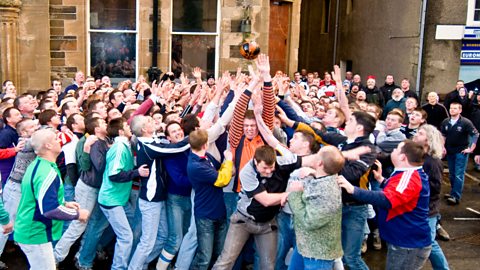
The Uppies and the Downies fight for the ball in the Christmas Orkney Ba game
Professional football is only a relatively recent invention - the first of the British Football Associations, the FA was only formally created in 1863 - but we’ve been having festive public games for hundreds of years.
Variations of the game known as medieval football, or mob football, are documented as far back as 1170. Games were often put on at Christmas and Easter and some of these ancient games are played today, such as The Orkney Ba game on Christmas Day and The Royal Shrovetide village game in Ashbourne, Derbyshire.
Football with an extra helping of football, please
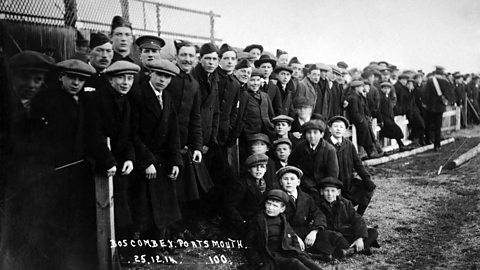
The good old days when football fans wore flat caps and had to sit in mud
Religious holidays and bank holidays have long been a time to pile on the football and there was a time when the top teams played nearly every day at Christmas.
In the Victorian era, “football was played on Christmas day because it was a day off and there was a tradition of public working-class events,” says history professor Martin Johnes. “It was also at times played on Boxing day meaning two games in two days.” For many working people this could be the only chance of the year to catch a game.
In his book Christmas and the British, Prof Johnes explains that bank holiday legislation played an important role: “The 1871 Bank Holidays Act gave Boxing day this designation in England and Wales. It had not done the same for Christmas day or Good Friday because they were established days of rest and worship,”
Football clubs took advantage of bank holidays as they offered the chance of bumper attendances. In the Victorian and Edwardian era, games were often arranged on Good Friday and Easter Monday, with some clubs playing up to three games in four days at Easter.
In 1913, Liverpool beat Manchester City 4-2 at home on Christmas Day, lost the return game 1-0 on Boxing Day, before drawing 3-3 at home with Blackburn Rovers the next day!
While Liverpool's fixture list won't be quite so intense this Christmas, one guarantee is that football will be played on Boxing Day.
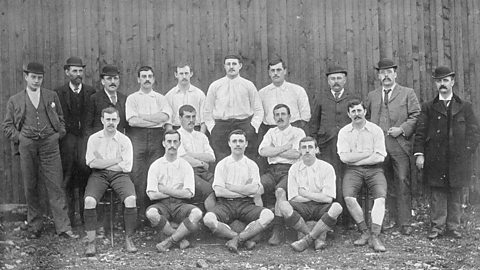
Fancy a game?
A cosy domestic scene is a cornerstone of Christmas today, but in the Victorian and Edwardian era people would have preferred getting out of the house to celebrate.
“For the working class, whose residences were often uncomfortable, overcrowded and unappealing, a rare day free from work was reason to take to the streets, not relax at home,” writes Prof Johnes.
Between World Wars One and Two there were sporting events, pantomimes, cinema showings, folk rituals and informal gatherings on Christmas day.
The ghost of Christmas past
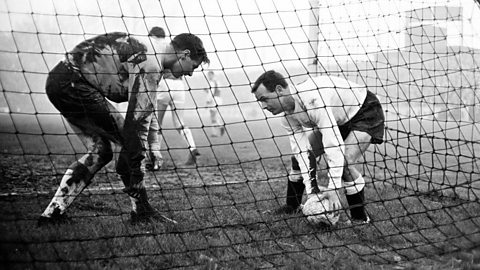
Fulham 10-1 Ipswich Town, league match at Craven Cottage, Boxing Day, Thursday 26th December 1963
Over the years, the popularity of Christmas day football dwindled. As living standards have improved and food, gifts and decorations have become more affordable. “Communal entertainments were clearly on the decline as the festival took greater root in the home,” says Prof Johnes.
“Football shifts just to Boxing day, as Christmas day becomes more family orientated and more importantly public transport becomes more and more limited.”
The last Christmas Day game in England was in 1965, when Blackpool beat Blackburn Rovers 4-2 at Bloomfield Road.
The last Christmas Day game in Scotland was Saturday December 25, 1976. Clydebank and St Mirren drew 2-2 in a top-of-the-table first division clash and Alloa beat Cowdenbeath 2-1 at home in the second division.
Northern Ireland still hosts the Steels of Sons cup final every Christmas Day - although it shifts to Christmas Eve if Christmas is on a Sunday.
Abstaining on religious grounds
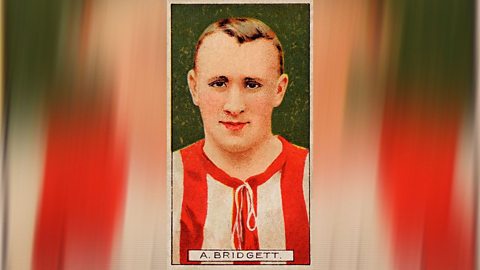
Sunderland forward Arthur Bridgett refused to play football on religious holidays
Even though local derbies were often scheduled for Christmas, the demanding schedule put a strain on the players with all the travelling that would have been involved.
If a club misses a game today severe penalties can be administered, but FA rules at the time stated “no club shall be compelled to play any match on Good Friday or Christmas Day”.
Swindon Town’s Harold Fleming (who played from 1907 to 1924) and Sunderland’s Arthur Bridgett (1902 to 1924) were high profile England International players who refused to play on Christmas Day on religious grounds.
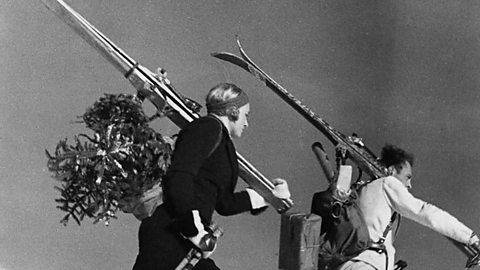
In Germany, they’re more likely to take their tree for a ski than play football at Christmas
As to why our Christmas football habit contrasts so much with our European neighbours, Dr Alexander Jackson, National Football Museum Curator, suggests it could be down to football being such a traditionally popular spectator sport in Britain.
“It is difficult to say exactly why Christmas games are definitely not a tradition in other countries. Perhaps, the early spread of football in England, comparative to European countries, where it only became a mass spectator sport after World War One, helps explain why it became embedded in Victorian and Edwardian football culture.”
It’s not the absence of Christmas football in Germany and other parts of Europe that’s surprising - it’s the tradition of Christmas football in Britain that seems a bit odd.
Love it or loathe it, there’s no denying that football is a particularly treasured part of British culture older than many well established Christmas customs practised today.
This article was written in December 2019 and updated in December 2025.