 1 month ago
60
1 month ago
60
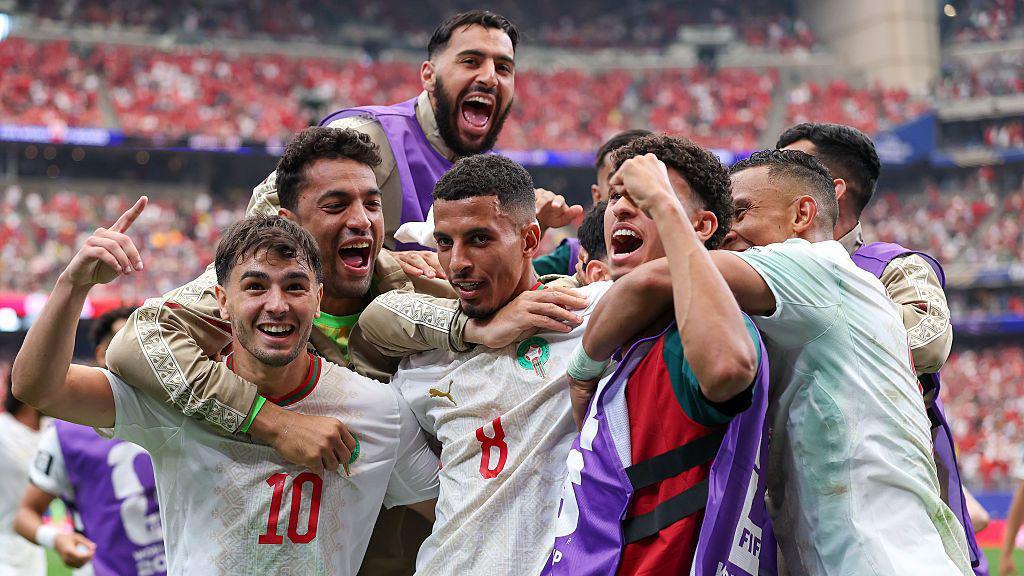 Image source, Getty Images
Morocco are currently ranked sixth in Fifa's world rankings
"Morocco have the potential to be a powerhouse of world football."
It is a bold statement, but Welshman Neil Ward has witnessed the country's passion and plans first hand.
After serving as chief executive at the Football Association of Wales Trust, Ward left his homeland to take up a role as director of technical operations at the Royal Moroccan Football Federation (RMFF) in 2020.
He was in Rabat when Morocco became the first ever African nation to reach the World Cup semi-finals a couple of years later.
Ward saw how "it took over all the city right through until the early hours of the morning, with the king out celebrating as well".
The Atlas Lions were knocked out by France, but they are now bidding to make history once more as they face Les Bleus again on Thursday (21:00 BST) for a place in the last four.
Whatever happens at Boston Stadium, it does not feel like the co-hosts of the next World Cup in 2030 are finished yet.
Another Briton, Simon Jennings, knows that better than most.
As well as delivering the Uefa Pro Licence and A-licence as a coaching educator, he was responsible for youth development across Morocco between 2020 and 2024.
"This is not an accident," he said. "It's a result of clear national ambition."
'These people are serious and want to be successful'
Such ambition has come from the very top.
There has been sustained investment in the game, which has been backed by King Mohammed VI.
Significant sums have been pumped into a state-of-the-art training facility, a national academy, regional training centres, stadium redevelopments and thousands of amateur pitches.
"You need those top facilities for players in Europe who are used to it," added Ward.
"So when you come in and see a training facility of this calibre, it shows you these people are serious and want to be successful."
Youth protesters have called for such funds to be channelled into education, healthcare, housing, transport and job creation.
In response, the royal palace vowed to allocate the equivalent of £11.2bn in the 2026 budget to health and education, which represents a 16% increase year-on-year.
For Ward, who worked for the RMFF between 2020 and 2024, the motivation behind the country's investment in football is clear.
It is about tapping into Morocco's passion for the game and grabbing "soft power on the international stage" by proving they can compete.
There has been a shift in mentality in that regard.
Going into the 2022 World Cup, Morocco had only once previously reached the knockout stages of the tournament, when they progressed to the last 16 in 1998.
However, before a ball was even kicked in 2022, former manager Walid Regragui made it clear to his players they were not merely travelling to Qatar to play three group games.
They were going to do something big.
Bouaddi, Lamine Yamal and the diaspora
Morocco have had the talent to do so with the help of their diaspora, as well as those players born in the country.
The country's ministry of foreign affairs, external estimates more than five million Moroccans live abroad.
Morocco have sought to identify and reach out to promising players with such roots at an early stage by deploying full-time scouts in France, the Netherlands, Spain, Germany, Norway, Sweden and Denmark.
Jennings said they are "embraced as Moroccans".
"You don't get a feeling that it's a second nation," he said. "They are totally into being Moroccan. It's a passion they have and a nationality they feel strongly about."
The results are rather striking.
Nineteen of the 26 members of Morocco's current World Cup squad were born outside the country.
Six of these individuals were also eligible to play for quarter-final opponents France, including highly rated Lille midfielder Ayyoub Bouaddi.
Although the 18-year-old represented Les Bleus throughout the age groups at youth-team level, he was always proud of his heritage.
So too was Spain's teenage starlet Lamine Yamal, who has a Moroccan father, and the RMFF even met and presented to him and his family.
Ward stressed "no stone is left unturned" when it comes to talent identification, even if it does not always come off.
"I remember they were talking about Yamal, this huge prospective talent at Barcelona, when he was about 12 or 13 years of age," he recalled.
'This oxygen is spreading very fast'
The next step for Morocco is to bring more senior internationals through the domestic production line.
Chris van Puyvelde, who was technical director at the RMFF between 2022 and 2025, said the target by the next World Cup was to have an equal split between Moroccan-born players and those raised elsewhere.
But he warned the "total organisation inside the country needs to be better".
There is a delicate balance to strike, given the increasing demand for results.
Morocco manager Mohamed Ouahbi previously experienced the need for success after his under-20 side failed to qualify for the African Nations Cup in 2023.
However, with renewed backing, and a degree of patience, the Belgium-born Ouahbi and his staff went on to win the Under-20 World Cup in 2025.
He was promoted to the role of senior team manager just a few months later after Regragui resigned in the aftermath of the senior African Nations Cup debacle.
Ouahbi quickly had to turn the page before the World Cup, but the RMFF also had an eye on the future after he was handed a deal until the 2030 edition.
It feels like Morocco are literally building towards something as the country prepares to co-host the next World Cup with Portugal and Spain.
"They are building stadiums, but they are also building the structure from the down up," added Van Puyvelde.
"Once you get a little bit of oxygen, like Morocco did in Qatar, you see this oxygen is spreading very fast. All over the country."