 2 months ago
56
2 months ago
56

Ryan O'HanlonMar 27, 2026, 07:00 AM ET
- Ryan O'Hanlon is a staff writer for ESPN.com. He's also the author of "Net Gains: Inside the Beautiful Game's Analytics Revolution."
Let's take a minute to do something I'm not sure has ever been done before: think about all of the things that went well for the U.S. men's national team at the last World Cup.
Their best player -- and the best player in the history of the program -- played like it. Christian Pulisic risked the future of his lineage to score the winning goal in the final match of the group stage against Iran. He either scored or assisted every goal the U.S. generated in Qatar, and he backed that up with consistent threat. He led the team in both expected assists and expected goals. You can't ask for much more than that.
Timothy Weah balanced out the other side of the attack, scoring the opener against Wales and stressing the depth of the opposition backline. The Europe-based midfield of Weston McKennie, Yunus Musah and Tyler Adams was the strength of the team -- most notably nullifying England in a group-stage match in which the Americans contested possession high up the field.
The fullbacks, Sergiño Dest and Antonee Robinson, were vital buildup-play engines: the former with his passing and dribbling, the latter with his never-ending off-ball running. Tim Ream, in his first World Cup at age 35, allowed the U.S. to control possession and build from the back in a manner we'd never seen at a World Cup. And Matt Turner looked like Matt Turner, even though he was riding the bench for Arsenal.
In other words, all of the best American players played like the best American players. The problem wasn't a lack of top-end talent. Obviously, Pulisic, McKennie, & Co. all need to play well this summer for Mauricio Pochettino's team to make a deep run, but the reality is that these are really talented players who play well more often than not.
Instead, what really hindered the Americans in Qatar -- and what, beyond luck, will determine how far they advance this summer -- was their depth, or lack thereof. Every team that wins the World Cup has depth, and the USMNT didn't have it four years ago.
- No more "inmates running the asylum": How Pochettino changed USMNT
- Is USMNT striker group the best it's ever had for a World Cup?
- USWNT transfer grades: Every American move assessed
How important is depth at the World Cup?
To answer this question, I went back and looked at the past 16 World Cup semifinalists.
In 2006, soccer was still stuck in that reactive tactical netherworld created by Jose Mourinho and Rafa Benitez, but by 2010, Pep Guardiola's possession-based approach had won out, and the physicality of Jurgen Klopp's gegenpressing was just beginning to bubble up. The demands of the game were quite different in 2006, so I decided to cut off the analysis there.
I looked at the semifinalists because these are the four teams who have objectively achieved success at the tournament, and then I looked at how each team employed its bench players. In other words, how important was depth to the teams that did well at the World Cup?
First, here's a comparison of the average percentage of minutes played by the 12th- through 16th-most used players across the 16 semifinalists:
Player: Avg. Min. %
12th: 42.6%
13th: 34.6%
14th: 28.8%
15th: 21.9%
16th: 16.9%
And here's how those numbers broke down, per tournament:
So, 12th-man usage has remained pretty consistent over time, but the reliance on players 13 through 16 has risen significantly. That's driven by a combination of a growing understanding that managers should be subbing more often, and also the increase from three subs allowed per game to five since after the COVID-19 pandemic.
But there's a bit of noise in these numbers since two of the semifinalists ultimately play in a third-place match in which they're rarely selecting their full first-choice starting 11. That's probably going to boost the number of minutes for all of these players. If we only look at the eight finalists from the past four World Cups, then this is how the minutes have been distributed:
Player: Avg. Min. %
12th: 40.4%
13th: 33.4%
14th: 28.5%
15th: 20.3%
16th: 13.7%
That's not much of a difference, but it's a slight decrease in every slot.
As for the per-tournament numbers of the finalists:
Of course, there have been specific quirks to each tournament. The 2010 World Cup was played in the South African winter. The 2014 World Cup featured cooling breaks because it was so hot in parts of Brazil. The 2018 World Cup was in Russia and yet ... mostly normal? And then 2022 in Qatar was played in the middle of the club season -- in December, instead of June.
Given how hot it's likely to be in the United States this summer, the peak numbers from 2022 feel like the right ones to guide us the rest of the way. They might even be a little too conservative.
In Qatar, France manager Didier Deschamps doled out his minutes like so:
12th: Ibrahima Konaté, Liverpool center back: 44.2%
13th: Youssouf Fofana, Monaco midfielder: 34.1%
14th: Randal Kolo Muani, Eintracht Frankfurt forward: 27.3%
15th: Kingsley Coman, Bayern Munich winger: 25.0%
16th: Marcus Thuram, Inter Milan forward: 22.3%
And here's how it looked for coach Lionel Scaloni, as he guided Argentina to its third World Cup trophy:
12th: Lisandro Martínez, Manchester United center back: 43.6%
13th: Angel Di María, Juventus winger: 42.0%
14th: Lautaro Martínez, Inter Milan forward: 34.5%
15th: Leandro Paredes, Juventus midfielder: 32.5%
16th: Gonzalo Montiel, Sevilla fullback: 17.1%
Winning the World Cup probably requires at least four players beyond your most-used 11 who play 25% of the minutes or more. And in 2022, those players pretty much all had to play for Champions League or Champions League-quality teams.
How did the USMNT compare?
In 2022, Ream, Adams, Turner, Musah, Robinson, Dest, Pulisic and Weah all played at least 85% of the minutes. McKennie was the only member of the true core who was below that mark, but he was still out there 75% of the time.
As for the bench, well, there wasn't much of one. This is how the USMNT's usage compared to France and Argentina:
And these were the players:
12th: Haji Wright, Antalyaspor forward
13th: Brenden Aaronson, Leeds United winger
14th: Cameron Carter-Vickers, Celtic fullback
15th: Giovanni Reyna, Borussia Dortmund attacking midfielder
16th: Jesús Ferreira, FC Dallas forward
Now, part of the reason the U.S. numbers are so low is that they played only four matches, and France and Argentina played seven, including the unforgettable final that went all the way to penalties. It's natural that the managers would need to dig deeper into their rosters as the number of overall minutes ticked upward.
You might also want to look at this and blame U.S. coach Gregg Berhalter for not managing his squad more aggressively -- but when you look at the players and how they performed, it's hard to really blame him. Wright mostly looked out of place, and his goal against the Netherlands in the round of 16 was a happy accident that ricocheted off of his heel. I will also never forget the moment against the Netherlands when Aaronson squared up 32-year-old Daley Blind, who was pretty much a human traffic cone at this point in his career, for a 1v1 and got stone-walled.
Carter-Vickers came in for the Iran match and was fantastic, but he's a center back. Reyna's family was trying to get Berhalter fired during the tournament, and he was completely forgettable in his round-of-16 cameo and then for the rest of the club season afterward. Ferreira, meanwhile, just wasn't at the same level as his other teammates.
The nine core players for the U.S. in 2022 were all playing, or had recently played, at a high level in Europe -- but that was it. The fact that Berhalter rotated out Walker Zimmerman for a must-win match speaks to the uncertainty of the center back spot next to Ream, and then center forward, with Wright, Ferreira, and Josh Sargent all getting chances, was a black hole.
This wasn't a roster equipped to handle a deep run.
What about the 2026 World Cup?
This is where I encourage U.S. fans to have some hope.
A few weeks ago, my colleague Jeff Carlisle projected what he thinks the starting lineup will be on June 12 against Paraguay at SoFi Stadium:
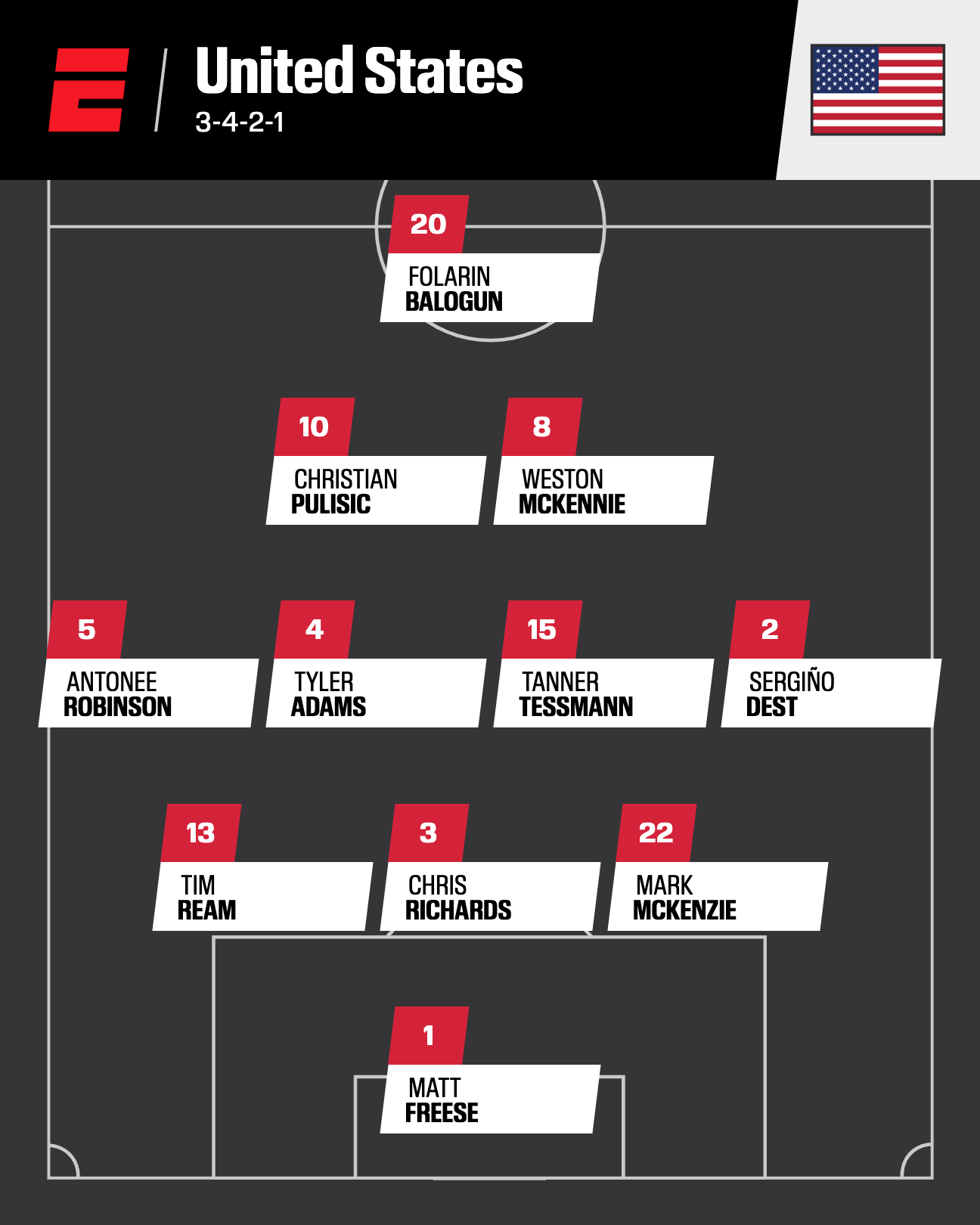
The biggest question is goalkeeper, but otherwise I'd say this is inarguably a better lineup than what we saw in Qatar. Ream is four years older, but Chris Richards and Mark McKenzie are big upgrades on the other center backs who played in 2022. And then, obviously, Folarin Balogun is way ahead of where any of the U.S. strikers were four years ago.
But what about the players who might occupy those 12th-through-16th depth roles?
There's Weah, who started in 2022 and is currently a starter for Marseille, the third-place team in France. There's midfielder Johnny Cardoso, who just played all 180 minutes of Atletico Madrid's dominant win over Tottenham in the Champions League's round of 16. There's attacking midfielder Malik Tillman, who has played about two-thirds of the minutes for Bayer Leverkusen, another Champions League team.
PSV forward Ricardo Pepi seems likely to move for tens of millions of dollars at some point really soon. Fullback Alex Freeman just moved to Villarreal, who are in third behind Real Madrid and Barcelona in LaLiga, for €3.5 million. Hybrid defender Joe Scally continues to play every minute of every game for Monchengladbach in the Bundesliga.
Even the likely bench players who were on the bench four years ago have improved. Wright is second in the English Championship with 14 non-penalty goals, and he's doing it for a team with a 22-point lead atop the table. Aaronson is scoring and assisting goals at double the rate he was at with Leeds in 2022.
There are a number of other really good Championship players, Aidan Morris and Patrick Agyemang, and the MLS players this time around, specifically Cristian Roldan and Max Arfsten, look more likely to have a positive impact than what we saw the last time.
If the U.S. is going to win at least one knockout round match, then it's going to need memorable contributions from the players who don't start every match.
While we're still waiting for the first true American superstar to emerge, Pochettino will head into this summer's tournament with something no American manager has ever had: a bunch of Champions League starters and European stalwarts, sitting on his bench.
In other words, if depth is necessary for a deep run at the World Cup, this iteration of the U.S. men's team has a chance to go further than it has gone in a long time.